Thursday, August 16, 2012

Internship Advice from an Intern

As the education coordinator, I've had interns off and on for the last 10 years.  Some are paid, the early ones were not.  These talented individuals become a valuable part of our organization in their year with us.  So I thought a post about internships from our current intern, Hannah George, would be worthwhile.  If you are a college student, have children in college, or are in a position to hire an intern, here's a perspective that may interest you.  Enjoy!


This year I have the enormous privilege of working for the ODNR Division of Wildlife as the education intern. This is the second internship I have had during my college career and I just wanted to share how important I feel internships are in preparing students for the real world and finding a job after college. Enjoy and please pass along to anyone you think could benefit.
 Getting an internship is a very important part of anyone’s college education. In my opinion, grades are secondary to training and work experience, especially in science-based fields. While grades are significant, they are not the only factors that contribute to success after college. Classes give us the basic knowledge and fundamental tools to be successful in whatever field we choose. But making connections and gaining first hand experience is what really makes the difference when it comes to finding a job once the cap and gown has been hung back up. Internships also help us decide if we even like the field we have chosen, or if we need to look elsewhere for something that better suits our passions and interests. Although internships are very important, it does not make it OK to slack off in classes. A slacker in the classroom is often a slacker on the job, and to make an impression or even find an internship, good grades are a must.
Internships are great tools for expanding experience. Whether it’s in the field, in a lab, or in an office, experience in each of these places and more is something that cannot always be learned from a classroom. The one-on-one instruction that goes along with internships is what makes them so great.  And once you’ve got the hang of the basics, you have the opportunity to improve in what you do by practicing everyday and applying what you’ve learned in the classroom to your tasks. A single internship can also offer very diverse experiences. Each day can offer something completely different from the last and use skills developed not only from your major classes, but even from classes you never thought you’d use. **Cough** GEC’s.  
 Internships are also a great way to decide if you are even in the right field. If you get an internship while you are still in school and decide that it is not the right place for you, you still have time to make the proper adjustments to your major or better understand what kind of job you want after college. Do you like an office setting, or do you prefer to work in the field? Do you even like anything about what you are doing? If not, it may be time to reevaluate your major and pick something that you think you will enjoy more. Once college is over, there is not much you can do to switch fields completely without going back to school. So try out as many options as you can and figure out what works best for you, preferably before graduation.
 Another reason internships are so important when it comes to job hunting is because of networking. The more people who know who you are or even just recognize your name, the better chance you have of finding a job. It is important now more than ever to meet the right people and make the right impressions. In many cases, who you know can become just as important, if not more, than what you know. Getting your foot in the door is the first step when looking for a job and already knowing someone on the inside can make a huge difference.
 Contrary to popular belief and reality TV, most people have to work hard and make sacrifices to land that dream job. Your social life and extra-curricular activities may have to take a hit in order for you to ultimately get what you want, but it is completely up to you what sacrifices and trade offs you are willing to make.

             As I’ve said before, grades are important, but the life lessons and experiences to be learned on the job during an internship are what really pave the way to success as well as happiness. So get out there, work hard, and APPLY, APPLY, APPLY to all kinds of internships!


Hannah George is a senior at the Ohio State University in Fisheries and Wildlife Management.  She will graduate this spring.  We'll be  very sad to see her go.

Monday, June 11, 2012

In Support of Nature Education...Naturally

I have the good fortune in my position to oversee a grant program that helps support the state park naturalist positions in our ODNR-Division of Parks and Recreation.  In exchange for this funding, the naturalists have to devote half of their programming to wildlife and wildlife-related topics.  Seems like a no-brainer, right?

I attended the All-State Naturalist meeting last week and was very glad to see a lot of folks I hadn't seen in several years, and a lot of new faces.  Due to budget constraints, this all-naturalist meeting had been reduced in size and scope the last couple of years.  I was very glad to see it brought back.  I think these folks need some dedicated time to network and interact with each other.  They were able to bounce ideas off of each other on topics like starting up a geocaching program, dealing with various ages of kids at their programs, drumming up attendance, and interactions with their local community.  I can say, without reservation, that this is a dedicated, passionate and fairly under appreciated group of people.  They are often the face of that park, the go-to person for issues, complaints, suggestions and more from the park patrons and the surrounding community. 

So, why would the ODNR-Division of Wildlife support naturalist in their sister agency?  Because it's a good investment for the Division of Wildlife.  These naturalists probably number around 50 across the state, but compared to the 8 full time education staff in our agency, they reach thousands more people per year than we ever could.  Many years, they reach well over 200,000 park attendees with wildlife-related programs each year.

Why is this a good investment?  With today's public spending less and less time outdoors and growing more and more disconnected to wildlife, park naturalists have a natural opportunity to help their patrons learn more about the nature around them.  A camper, while likely an outdoor enthusiast already, may not have a good base of knowledge about the wildlife and the quality habitat that is around their campgrounds, homes, and parks.  And, whether it's the roaming naturalist with an owl or snake that talks to the campers, or the naturalist that conducts the regular Saturday evening night hike, or the naturalist that helps the community do an annual creek clean-up, these small, intimate contacts with nature are often the ones that spark the enthusiasm, interest and desire in children and adults to participate in nature even more.  Whether it's simply wanting to learn more about what they are seeing on the trails, or wanting to learn how to take a fish off of a hook, park naturalists are in a unique position to have a real impact on creating a positive experience in nature.

So, the next time you visit an Ohio State Park, seek out the naturalist and thank them for their passion, time and effort.  And tell them I said hi and thanks too!

Wednesday, April 11, 2012

National Poetry Month...with a wildlife twist

April is National Poetry Month! From the Poets.org website: "Inaugurated by the Academy of American Poets in 1996, National Poetry Month is now held every April, when publishers, booksellers, literary organizations, libraries, schools and poets around the country band together to celebrate poetry and its vital place in American culture. Thousands of businesses and non-profit organizations participate through readings, festivals, book displays, workshops, and other events."


Poetry has held a place in many cultures for thousands of years.  The Japanese consider it an art, European authors have expressed political and cultural messages and feeling though poetry for centuries.  And, in America, many naturalists have used peotry to convey the beauty of the American landscape for generations.  Some examples include:

Low-Anchored Cloud
Low-anchored cloud,
Newfoundland air,
Fountain-head and source of rivers,
Dew-cloth, dream-drapery,
And napkin spread by fays;
Drifting meadow of the air,
Where bloom the daisied banks and violets,
And in whose fenny labyrinth
The bittern booms and heron wades;
Spirit of lakes and seas and rivers,
Bear only perfumes and the scent
Of healing herbs to just men's fields!
by Henry David Thoreau


The Dalliance of the Eagles
Skirting the river road, (my forenoon walk, my rest,)
Skyward in air a sudden muffled sound, the dalliance of the eagles,
The rushing amorous contact high in space together,
The clinching interlocking claws, a living, fierce, gyrating wheel,
Four beating wings, two beaks, a swirling mass tight grappling,
In tumbling turning clustering loops, straight downward falling
Till o'er the river pois'd, the twain yet one, a moment's lull,
A motionless still balance in the air, then parting, talons loosing,
Upward again on slow-firm pinions slanting, their separate diverse flight,
She hers, he his, pursuing.
by Walt Whitman


Writing and poetry are fantastic ways to help kids learn more about nature and wildlife.  And, as you can see in the above examples, poetry allows for beauty and expressiveness that can often be left out of regular narrative writing. 

One exercise that we've often done with students and adults is the Project WILD activity Animal Poetry.   The objective of this activity is to help students recognize and experience the inspirational value of wildlife through poetry.  The students spend time outside and imagine themselves as animals, then write poems about that experience. 

Some suggested poem formats include Haiku, which is a Japanese lyric verse form that has three unryhmed lines that have 5, 7 and 5 syllables.  Haiku traditionally and ideally presents a pair of contrasting images: one suggestive of time and place, the other a vivid but fleeting observation.  When they work together, the poem evokes mood and emotion.  An example follows:

The hawk soared over
Spirit bird in my living
Guide to harmony

Any guesses on what species of hawk this is?
 Another suggested format is Cinquain.  This is an American derived format that is comprised of five unrhyming lines of, respectively, two, four, six, eight and two syllables or words.  Each line has a purpose and number of syllables or words as follows: line 1 is a title of two syllables (words), line 2 is a description of the title in 4 syllables (words), line 3 is a descriptive action in 6 syllables (words), line 4 is a description of a feeling in 8 syllables (words) , and line 5 is another word for the title in two syllables or words.  An example follows:

Bobcat
Vital, quiet
Moving swiftly to live
Endangered by human patterns
Near lost

And finally, Diamante is a poem that can be used with students.  It is a poem shaped in the form of a diamond.  It can be used to show that words are related through shades of meaning from one extreme to an opposite extreme, following a pattern of parts of speech like this:

noun
adjective  adjective
participle  participle  participle
noun  noun  noun  noun
participle  participle  participle
adjective  adjective
noun

If you are having trouble remembering what a participle is, it is word that functions as a verb, but ends in ing or ed.  So you might be "carrying" something, carrying is a participle.  An example of a Diamante follows:

egg
light bright
living stretching growing
bird beak wing flight
soaring seeing seeking
feathered fluid
crow

Students can take their completed poems and type them or print them neatly and then display them with their focus animal, either illustrated or with a photograph.  Some follow-up questions to ask the students after their lesson could be a discussion on why some people say they would not want to live in a world without animals, would they want to live in a world without animals, what kinds of wildlife would they want to see regularly, and why.

So, enjoy April as National Poetry Month. And take your kids outside to find all that nature has to offer for inspiration.  There is no shortage no matter where you are.  You just have to look for it!


Wednesday, March 21, 2012

Invisible Ink-a guest blog by Herb Broda


Photo from the Appalachian Mountain Club's Web Site
 I will often reference other blogs that are relevent to the topic of outdoor, environmental and/or wildlife education here.  It's my pleasure today to reference one of my favorite people, Herb Broda with Ashland University, and his recent post on the Children and Nature Network's Blog.  Herb looks at how changes in children's literature are unfortunately a reflection of the decline in time spent outdoors by today's youth.  Enjoy!

Invisible Ink: Is the Natural World Disappearing from Children's Books and Education?


Herbert W. Broda is a professor of education at Ashland University in Ohio. He is the author of "Schoolyard-Enhanced Learning: Using the Outdoors as an Instructional Tool" and "Moving the Classroom Outdoors: Schoolyard-Enhanced Learning in Action." He is also a leader of the Children & Nature Network's Natural Teachers Initiative.

Friday, March 16, 2012

March Madness Has Gone Wild!

My husband and I are big NCAA basketball fans, him more so than me.  He keeps track of all the teams, fills out his brackets, and is at one of the tournament games as I write this.  I get to go with him on Sunday and I'm very excited. 

I didn't get a chance to fill out a bracket this year, but as we were discussing some of the match ups and potential match ups for Sunday, I noticed a theme.  There are a huge number of teams in the tournament this year that have wildlife-related mascots.  Now, I realize that if you're not a wildlife geek like me, you may not have picked up on this. But I did and, after some investigating today, here's what I found.  Out of the 64 teams in the tournament, almost half (30) have a wildlife-related mascot.  Here's a more specific breakdown of those 30*:
  • 9 are characterized as some type of non-domesticated feline, aka Wildcats (3), Cougars, Bobcats, Tigers (2), or Catamounts. And throw in the Bearcats too if you want, I'm not sure where to put them.
  • 5 are characterized as some type of raptor, aka Golden Eagles (2), Mountain Hawks, Owls, and if you want, you can put the Jayhawks in there too.
  • 3 are characterized as some type of bear, aka Bruins, Grizzlies and, uh, Bears.
  • 3 are characterized as some type of songbird, aka Cardinals, Blackbirds, and Bluejays.
  • 2 are characterized as some type of wolf, aka Lobos (Spanish for wolf) and Wolfpack.
  • 2 are the Rams with mascots that look like Big Horn Sheep.
  • 2 are in the Mustelid Family with the Wolverines and the Badgers (as a Buckeye graduate, that was really hard to type.)
  • Finally, there are 1 of each of the following wild critters to cheer for: Jackrabbits, Gators, and Buffalos.
Why would I take the time to add all of this up?  It's because I think, culturally speaking, it shows the value and the esteem with which we, as a society, hold these animals.  Now, don't get me wrong, I don't think that the Kentucky Wildcats are going to go the whole nine yards simply because of their name.  But, if you're going to pick something to be a mascot, what kinds of characteristics do you want your mascot to embody?  Strength, fearlessness, beauty, courage, etc.  We tend to apply these anthropomorphic characteristics to wild animals because as we learn about their habits, we learn to respect them and maybe even fear them a little bit.  But, regardless of how you feel about an animal, picking it as a mascot can be a sign of respect and admiration. 

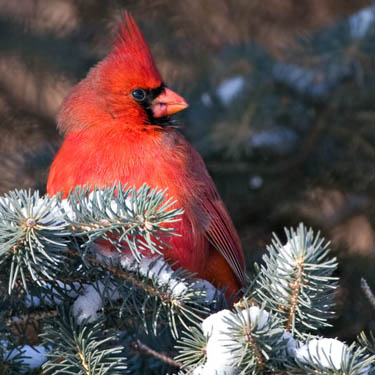
By the way, if you're sitting there wondering what is so powerful and intimidating about a cardinal, ask the caterpillar that it was trying to eat this morning.  Or ask the wildlife rehabilitator that is nursing a bite from its powerful beak.

As we move forward in the tournament, there have been some match ups that mimic real life, and some that do not.  For example, a Badger could never defeat a Grizzly in real life.  And a Golden Eagle probably couldn't whip a Couger.  However, a Bear could definitely take it to a Jackrabbit and a Golden Eagle would have its talons full with trying to take down a Wildcat.  So here's to the excitement and drama that is wildlife both on the court and out in the field.  And may the best critter win! 

Personally, tonight I'm hoping that the Memphis Tigers beat up the St. Louis University Billikens because WHAT THE HECK IS A BILLIKEN? Look it up! I did, and no offense to any of you Billikens out there, but if your mascot requires a full page definition, you might want to think about picking a new mascot.

Have fun everyone and Go Bucks!


(*If you're doing the math and you find I've only counted 29, that's because I threw in the Buckeyes because they can take out anything as a poisonous nut. ;-p)

Tuesday, March 13, 2012

Vernalpalooza! The Crazy World that Lies Beneath!


Spotted Salamander--Photo by Kipp Brown

Most days, I think I have one of the coolest jobs in the world.  I get to help people learn about wild animals.  It's fun, rewarding and I thoroughly enjoy it.  But once in awhile, even I get amazed at how cool my job is. 

I had the good fortune to host a workshop about vernal pools a couple weeks ago down at Shawnee State Park Lodge called Vernalpalooza.  We invited around 40 educators from across Ohio to come down for three days to learn about and experience the facinating world that is one of our most unique and, unfortunately, declining habitats in the state. 

For those that don't know, vernal pools are small, pocket wetlands that are usually found within woodland areas and only hold water in the spring and early summer, hence the term vernal.  They are free of fish, can be ground water or surface water fed, and are the nurseries to dozens of species of frogs, salamanders, aquatic invertebrates, and more.  On warm, early spring nights, especially if it's raining, you can find salamanders migrating en mass to these pools to breed.  In some parts of the state, roads are closed to traffic to minimize damage to these populations from vehicle traffic.


The objective of the workshop was for the participants to not only learn about vernal pools, but how to construct them in areas that could be used for educational purposes.  We had some outstanding and extremely knowledgeable instructors on topics such as vernal pool construction, vernal pool ecology, vernal pool monitoring, funding, collection and monitoring permits, and linkages to state education standards.  Overall, I think the participants learned a lot about these fragile and critical habitats and how to use them for education in a safe and ethical manner.


Exploring the pools-Photos by Jim McCormac
But, the best part for me was the field trip! We were very fortunate to have the opportunity to access the General Electric Jet Engine Testing Grounds in Adams County.  This 7,000 acre property is literally out in the middle of nowhere.  And, fortunately, it has been left alone for the most part on the areas that are not used by GE.  So, there are some phenomenal examples of vernal pools that we were able to explore.  We first went to a natural pool that was absolutely amazing.  You couldn't move without seeing spotted salamanders and their egg masses, some lingering Jefferson's and their egg masses, wood frogs and egg masses, fairy shrimp, and we were even fortunate to find a fairly rare four-toed salamander hiding under the moss.  The second pool was a constructed pool and it was just as interesting, although not as productive.  It was significantly younger in age than the first pool, but you could tell it was well on its way to becoming prime habitat for the area.  It was a tremendous exploration and you could hear everyone's excitement in their voices as they walked around and found all these treasures.  Some squealed with delight, others laughed with pure joy.  As a coordinator, it was so amazing to watch the sheer joy on the participant's faces.  For me, that was the best part.  Check that, I have THE coolest job in the world!

Here are some photos from the workshop.  If you'd like more information about our upcoming workshops, sign up for our E-Newsletter online at http://www.wildohio.com/  Be sure to select the Educator Edition. 


Wood Frog eggs
Photo by Jim McCormac


The Entire Crew
Photo by Kipp Brown

Spotted Salamander--Photo by Jim McCormac

Wednesday, January 18, 2012

Wildlife Education Loaner Kits are rolling into a classroom near you!

From guest author, John Windau, Wildlife Communications Specialist in the District Two Office, Findlay, Ohio.

     Are you looking for a way to bring some fun and excitement into your teaching sessions? Well, here are some great opportunities to bring wildlife education into your classroom using hands on learning kits available from the Ohio Department of Natural Resources (ODNR), Division of Wildlife. These kits are available in the form of loaner trunks, and can be borrowed for two weeks at a time from your district office. There are wide varieties of trunks available, and each district may be slightly different, but here is a general guide to what you may find.


     If playing with, err, I mean using plaster of paris or air dry clay sounds exciting to you, then the animal track trunk may be right up your alley. This kit contains rubber molds for various wildlife creatures found in Ohio. But wait, this is more than just an art project. Once dried, these impressions can then be used to help teach children about the animal tracks they may encounter in the wild and what habitat types each animal can be found in.

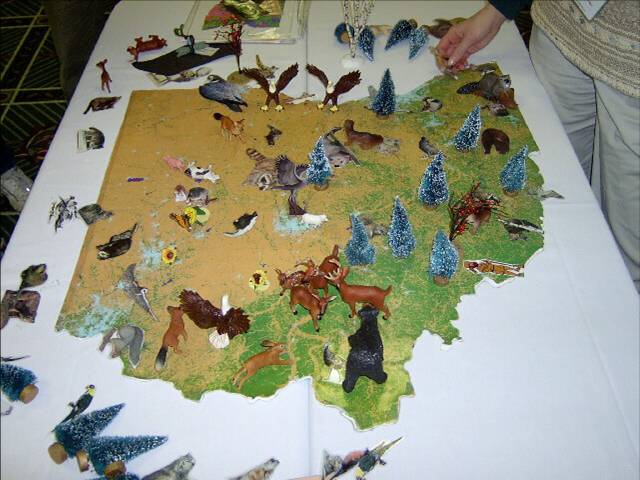
     Ok, if that sounds too messy for you, how about bringing in a map and a bunch of figurines? No, I am not talking about Candyland, Dungeons and Dragons, or Legos. The timeline activity is an interactive way to demonstrate how Ohio’s landscape has been impacted by settlement and development. Have your students interact with the map, tree and animal figures to see what impacts humans have had on Ohio through time.

    Like playing in water? How about a stream trunk? Inside you will find all types of cool gadgets (that is the technical term) for sampling streams for insects, invertebrates, and small fish. Not a stream expert? Included along with the dip nets, magnifying glasses, stream seines, are keys and activity guides that will help you along the way.

    If insects sound interesting, how about borrowing an insect trunk? Students will enjoy learning about the insects living around them. They can capture insects with the included insect nets, hold and analyze them in the special bug jars that have magnifiers already included. Field guides and posters will make identifying the bugs another rewarding challenge.

   Not everyone is comfortable with insects. Another excellent trunk is the fur and skull trunk. This trunk contains a variety of furs and skulls from Ohio’s wildlife. Students will enjoy guessing what type of animal the furs come from, as well as feeling how soft the pelts are. This is a great opportunity to introduce and teach children about the unique characteristics of individual species. Also included in this trunk are skulls from various mammals in Ohio. Ever stumble upon a skull in the wild and wonder what it was? Well here is your opportunity to learn to identify some of Ohio’s most common mammals using facial features and dental patterns.

    What about reptiles and amphibians? These fascinating groups of animals are some of the most primitive on the planet. Their unique lifecycles and abilities fascinate students. The reptile and amphibian trunk contains guides and replicas for students to explore what makes these unique animals tick, how they survive, and why they are so special in our environment.


Any guesses on this species?

    It may not seem like it now, but spring is right around the corner. Doesn’t a nice spring walk listening and looking for birds sound peaceful? The Division also has bird and birding trunks available. Field and activity guides will help guide you as you introduce birds and birding to your students. The kits also include binoculars, bird song CD’s, and other materials to help you along the way.

    If you haven’t guessed by now, the Division of Wildlife has a wide variety of resources available for educators. These are just a few of the kits available. In addition, there are dozens of publications, programs, and activity guides offered. Contact your district Communications Specialist to learn what else is available and how to make arrangements for borrowing one of these exciting kits for your students. You can find the Education Materials Brochure and the Ohio Division of Wildlife’s District contact information at http://www.ohioprojectwild.com/  

Tuesday, December 13, 2011

December is for the Birds

From guest author, Mary Warren, Naturalist at Magee Marsh Wildlife Area and the Sportsman's Migratory Bird Center, Oak Harbor, Ohio 


While you are out dashing around looking for the perfect gift, many folks will be outside counting birds. The National Audubon Society will sponsor the 112th Christmas Bird Count from December 14th to January 5th this year. While it’s not a
 BIG YEAR (did you get to see the movie The Big Year? Very funny!), it will be a big event.


On any day during that period, people will be out with binoculars and field guides in hand counting every bird, recording how many and what species, and where they are seeing them. Thousands of volunteers across the Americas will take part in this adventure that has been a tradition for years. You don’t have to be an expert to participate in the Christmas Bird Count (CBC). All eyes and ears are welcome. The data that is collected during these weeks is used to guide conservation actions for bird populations. This tradition began in 1900, making the CBC one of America's longest running wildlife census projects. And you can be a very important part of this fun citizen science project.

Most CBC’s are run through local Audubon chapters. You can go online to find a chapter near you. There are also informal CBC4Kids events sprouting up around the country. First introduced in 2007 in Sonoma Valley, California, this event is specifically for kids and families and encourages enjoyment and respect for nature together. For more info you can check it out at http://www.sonomabirding.com/

If you are in Northwest Ohio, there will be a CBC4Kids at Magee Marsh on January 14th, 2012. There will be lots of fun activities planned that day. For more info, you can email mary.warren@dnr.state.oh.us
From g2goutside.com


We hope that you will consider starting a new tradition this year by getting OUTSIDE to count the birds in your area and to take time to enjoy the beauty of our natural world!

Wednesday, November 23, 2011

Got H20?

I have decided to start posting more to this blog.  Life is busy and it's been a long time since my last post.  So, keep your eyes open for more to come.  We hope to offer more writers, more topics, and on a more timely basis.

This post is from one of our many guest authors, Jamey Graham, Wildlife Communications Specialist in our Akron office.  Enjoy!

Most people who enjoy backyard or schoolyard bird watching know that providing even the simplest of bird feeding stations will attract our feathered friends, not to mention a wide array of other wild creatures. What many folks don’t think about though is how well watering stations work at reeling in wildlife. In the midst of a snowy, winter day, birds might struggle a bit to find high-energy, nutritious food. But they often struggle harder in a battle to find clean, unfrozen water. Both humans and wildlife can go several days without food, albeit grumbling bellies, but our bodies must be hydrated much more frequently in order to function comfortably.


There are a couple of ways to provide a reliable supply of fresh drinking water for wildlife. And, as with many hobbies, a watering station can be as elaborate and expensive or simple and affordable as you want it to be. Obviously, a traditional birdbath works when temperatures don’t dip below freezing. Keep in mind that this water does not have to be deep. Most birds prefer the water to be very shallow, just a few inches.  So if you have a deep bowl, place a large rock in the center to help displace the H2O. When winter does indeed set in and the temps fall, a heated birdbath or water heater (for a terra cotta, concrete, granite or plastic bowl) will keep the water from freezing. You can purchase either of these at a home and garden department store or specialty supply store that focuses on attracting wildlife. Prices and selection vary greatly depending on where you shop of course. But plan on spending roughly $30-$80 for a good quality item that should last a couple of seasons if not more. You can purchase electric or solar energy products, but keep in mind that solar products tend to cost more initially, but will save you money over time.

As a side note, if you are struggling to attract critters to your feeding and watering stations, you may need to move these stations closer to habitat or plant some vegetation nearby. Birds feel especially vulnerable out in the open, so protective cover in the forms of shrubs, trees, and tall grasses can make a world of difference with your success at attracting wildlife.


Keep the water clean by changing it often-maybe once each week- and you’ll reap the rewards as will your avian visitors. If you need help identifying all of the wonderful birds visiting your property, check out the Division of Wildlife’s interactive guide for a free color guidebook and sound CD.

Tuesday, August 30, 2011

WANT YOUR KIDS TO GET INTO HARVARD? TELL ‘EM TO GO OUTSIDE! - Richard Louv

WANT YOUR KIDS TO GET INTO HARVARD? TELL ‘EM TO GO OUTSIDE! - Richard Louv

I'm reposting an interesting blog from Richard Louv, the author of Last Child in the Woods and The Nature Principle. I'd love to hear your comments on this idea, relative to Ohio. Let's hear what you think!